By: Lila Schaefer
In the Mediterranean region, where borders are so contested, the ability to hold space for oneself and for others offers great power. Spaces—from geographic landscapes to more domestic spaces like homes or restaurants—have the ability to impact the trajectories of social and political change because of their ability to create a sense of belonging and power.
In their book “How the West Came to Rule: The Geopolitical Origins of Capitalism,” Alexander Anievas and Kerem Nişancioğlu explain “spatial tunneling,” a phenomenon which divides the world into distinct regions that are able to be thought of as separate from others. The fragmentation in the Mediterranean, the perceived separation of the northern and southern coasts, can be attributed to this phenomenon (Anievas & Nişancioğlu, 24). Beste İşleyen and Nora El Qadim elaborate on this dynamic: “When applied to border and migration studies, spatial tunneling works through the portrayal of the Mediterranean Sea as a sort of a passage; a point of transit for mobile individuals to move from one enclosed and uniform space to another” (İşleyen & El Qadim, 4). Migration in the Mediterranean is defined by the difference between Point A and Point B, rather than the relationship between the two. Thus, the spatial fragmentation that occurs through the “tunneling” of the European, African, and Middle Eastern canons does not allow the cultural exchange that happens here to be recognized. Not only do these strong borders between the continents that make up the Mediterranean hinder our cultural and economic understandings of the region, they are also deadly. In a 2017 report for the United Nations Migration Agency, Philippe Fargues, Director for the European University Institute’s Migration Policy Center, explained that the separation of Europe from the southern Mediterranean creates “the world’s most lethal border” (Fargues, 13). Holding space for the Mediterranean as its own canon in popular media and academia could result in a decrease of the colonial and patriarchal influence both individuals and the region as a whole. While this idea of holding space in and for the Mediterranean has not taken hold in the mainstream dialogue, it is something that marginalized people in the Mediterranean turn to as a source of empowerment. Marginalized groups, particularly women or refugees, have been able to create spaces where they can express themselves without the colonial and patriarchal pressures imposed by “spatial tunneling” (Anievas & Nişancioğlu, 24). In this essay, I examine two different case studies: women’s community spaces in Barcelona and Rome (laSal and the Cooperativa Beato Angelico–or CBA), and The Living Room project which originated in Sweden. Both of these endeavors include artists creating space to promote liberation, social progress, and a decolonized world view within the context of the Mediterranean region more broadly.
When laSal—a women’s bar, café, library, and gathering place— was formed in Barcelona in the summer of 1977, founders Maria Jose Quevedo, Sat Sabater, Montse Sola, Carme Cases, and Mari Chorda stated: “This project has been taking shape, little by little, for a long time due to the increasing need for women to have a space, information, a possibility of expression and a platform of action with which we feel identified and that could help to assert our identity” (Almerini, 201). This emphasis on being “identified” parallels the power of identifying the Mediterranean as its own region. Before anything else, this statement of intention emphasizes the importance of this space and the positive contributions it makes to the lives of women and therefore, the lives of everyone in the community. Here, women were allowed a place to gather, think, and create in a place that was private from the outside world, but was a safe space for women. As a part of the second-wave feminist movement in Europe in the 1970’s, organizations like laSal and CBA were, in the words of Katia Almerini, “no longer subject to political games and no longer hierarchical” (Almerini, 206). In these spaces, people are brought together outside of the typical patriarchal societal structure that prioritizes the thoughts of some over others. The horizontal structure does not value any one individual over anyone else, so there is freedom for ideas to flow freely within the community in a way that promotes positive change, similar to how a multicultural view of the Mediterranean promotes an increase in understanding. This dynamic between public and private space, between the privilege associated with hosting/being hosted– and the lack of public space that women were encouraged to be in– created the need for spaces like this. Almerini also explains:
“I invite a consideration of these spaces as places where it was possible to host the process of creative liberation from the colonized imaginary. They allowed the possibility of looking for a new identity and a possible new artistic expression, over the conditioning of the known culture and the artistic traditions.” (Almerini, 208)
These private locations allow women to hold space for what makes them different—not in terms of race, gender or religion– but in the fundamental way that different people think and how they are influenced by their lived experiences. The space allows for the “expression (conscious or not) of the ‘different’ creativity of women, difference marked by her different relation and position within the cultured world, not by her biology” (Almerini, 208). A space free from public expectations allows this community of women to make something new, to express ideas as an individual in the community, and not just as a woman in society. The focused environment created by spaces like laSal allows for ideas to be spread without being hindered by the lower standing of women in larger society. Instead of defining a woman by “her biology” in society, we can value her ideas; instead of defining an individual in the Mediterranean by their nationality, we can value them as people (Almerini, 208). By considering all the different cultures of the Mediterranean together (not separated as European or African, Italian or Egyptian, etc.) we can move towards valuing the contributions of nations and individuals for what they are, rather than what continent they come from.
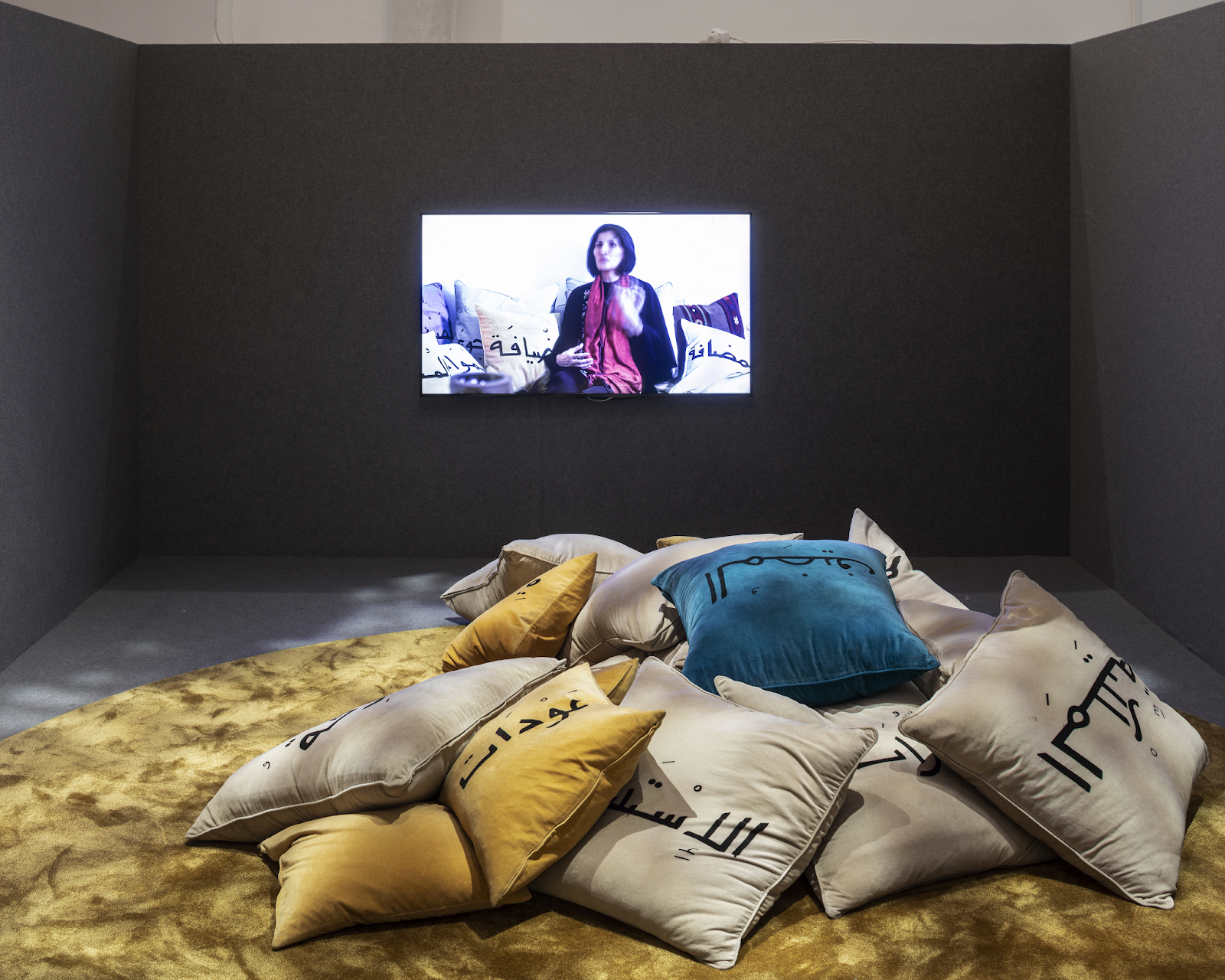
In the Living Room project (Al Madhafah in Arabic), we see this dynamic played out with an emphasis on hospitality as an artistic practice. The Living Room originated in Boden, Sweden, a town which “is largely viewed by its refugee community as a transitory place,” and was initiated by Palestinian artist and architect Sandi Hilal (Hilal & Petti, 363). The idea for the project was generated when Hilal visited The Yellow House in Boden, which hosts refugees, many from Arab countries. When she visited, she was accompanied by Swedish government officials, since she had been hired by them to create this public art project in a marginalized area. She was struck by the immediate shift in the power dynamic upon entering a Syrian refugee couple’s living room. Instead of the Swedish government officials holding the power as they would in a public space, the living room space in the couple’s home allowed the power dynamics to shift and feel more equal. To start the project, Hilal partnered with Yasmeen Mahmoud and Ibrahim Muhammad Haj Abdulla, the Syrian couple living in the Yellow House, to create a sort of public living room within the building. Feeling like this one space was not enough, Hilal created a Living Room exhibition setup in her own home in Stockholm. The project continued, with Hilal initiating Living Rooms in the guest apartments at NYU Abu Dhabi, The Women’s Program Center at the Farwar Refugee Camp, and in the “Public Luxury” exhibition at ArkDes in Stockholm in Fall 2018 (Hilal & Petti, 364).
We can see two setups for The Living Room at the ArkDes exhibit in Stockholm (Figure 1) and in the Yellow House in Boden (Figure 2). In these rooms, pillows and cushions with Arabic text on them are placed in the room as a way to incorporate the language of so many refugees into these unfamiliar environments. Not only is the premise of sitting on the floor with these pillows symbolic of the dismantling of social hierarchy, but it is a culturally inclusive practice. The furniture in the room is easily movable allowing those who use the room to set it up how they want, giving the feeling that this space belongs to them. In both of these spaces, there is a central, visual component that those in the room take in together. In the ArkDes exhibit, it is in the form of a projection on the wall– something that everyone can watch together. In the Yellow House, it is a large window that looks out onto the Boden scenery, allowing the refugees using the space to feel like a part of this new landscape while also maintaining their own community and cultural traditions in the Living Room.
Similarly, holding space for the Mediterranean to exist as a community of cultures, rather than a disembodied cultural crossroads, gives power to those who have been negatively impacted by the overwhelming separatism that colonial forces have imposed on the region. We should not only be studying Europe, North Africa, or the Middle East as separate historical canons. Rather, we should study these regions in the context of the Mediterranean as an overlap of cultures that are deeply connected. In Toward a Comparative History of the Modern Mediterranean, 1750–1919, Edmund Burke III explains: “Although the Mediterranean is the tri-continental hub where European, Muslim, and African civilizations converge, histories of the modern Mediterranean have instead tended to emphasize the boundaries between civilizations, not their histories of interaction” (Burke, 908). By studying the Mediterranean as a fragmented space, we fail to fully understand the complexities of regional dynamics. Although the holding of space in this sense is not the same as it is for a women’s club or living room, it is equally as important. In their book about cultural representations of gender, focusing on the Mediterranean, Maria Isabel Romero-Ruiz and Pilar Cuder-Domínguez illustrate the broader, global importance of holding space for marginalized people and their histories, and how this work is crucial in the Mediterranean:
“We adopt the Mediterranean as a vantage point from which to look on a globalized world, acknowledging on the one hand that the Mediterranean has for ages been a space of cultural encounters and hybridisation, and on the other, that on this day and age it is likewise subject to ongoing processes of exclusion and discrimination that must be open to our scrutiny.” (Romero-Ruiz and Cuder-Domínguez, 3)
Establishing the Mediterranean as its own space and studying it as such allows us to critically analyze how mainstream dialogues about the space it occupies have, historically, promoted separation, conflict, and a lack of belonging.


Bibliography
Almerini, Katia. “Women’s Art Spaces; Two to Mediterranean Case Studies.” All-women Art Spaces in Europe in the Long 1970s. Edited by Agata Jakubowska and Katy Deepwell, (2018): 189-208.
Anievas, Alexander, and Kerem Nişancioğlu. How the West Came to Rule: The Geopolitical Origins of Capitalism. Pluto Press, 2015. https://doi.org/10.2307/j.ctt183pb6f.
“ArkDes, Stockholm.” Decolonizing Architecture Art Research. https://www.decolonizing.ps/site/stockholm-arkdes/.
Fargues, Philippe. 2017. Four Decades of Cross-Mediterranean Undocumented Migration to Europe A Review of the Evidence. Geneva: International Organization for Migration. https://publications.iom.int/books/four-decades-cross-mediterranean-undocumented-migration-europe-review-evidence.
Hilal, Sandi, and Alessandro Petti. 2019. Permanent Temporariness. Stockholm: Art and Theory Publishing.
“”HOSTING IS A POWER AND BY HAVING POWER YOU BECOME VISIBLE”.” ArkDes. https://arkdes.se/en/hosting-is-power-and-by-having-power-you-become-visible/.
İşleyen, Beste, and Nora El Qadim. “Border and Im/Mobility Entanglements in the Mediterranean: Introduction to the Special Issue.” Environment and Planning D: Society and Space 41, no. 1 (2023): 3-13. https://doi.org/10.1177/02637758231157264.
Romero-Ruiz, Maria I., and Pilar Cuder-Domínguez. 2022. Cultural Representations of Gender Vulnerability and Resistance: A Mediterranean Approach to the Anglosphere. 1st ed. Springer International Publishing. https://library.oapen.org/bitstream/id/76ea808f-60af-4420-a58d-2fbdbf723ad1/978-3-030-95508-3.pdf.
