By: Isabelle Job
This essay will explore textiles in Tunisia with a focus on the role of women in their production and ingrained feminine associations with craft as an art form. Looking at Judith Butler’s ideas and using art historical gender theory, this essay will seek to explore the notions of what defines craft as feminine, in addition to what defines a woman in the cultural context of Tunisia during the French occupation in the late nineteenth and into the early twentieth centuries. Not only is the production of these textiles going to be discussed, but visual depictions of this labor by a French Orientalist artist will be analyzed. The ways in which these objects are symbols of femininity and their role in defining a woman will be explored, along with the impact that Orientalism has on our depiction of the labor and craft of women in Tunisia.
Textiles in Tunisia are traditionally made in the home by women’s labor, which is culturally entangled with gender identities. Unlike other cultures, in Tunisia, it is common for women and mothers to reside in the domestic sphere, as the home is viewed as a “public” space (Holmes-Eber, 16). Despite residing in the domestic sphere, women are known to participate in community events with family members. In actuality, a large portion of these activities include embroidery and weaving. In this way, femininity associated with Tunisian textile production is entangled with gender norms that define their cultural and political practices. As Judith Butler states, “it becomes impossible to separate out “gender” from the political and cultural intersections in which it is invariably produced and maintained” (Butler, 3). These gender norms in Tunisia were impacted by French occupation, during which a French Orientalist artist documented the labor of women textile artists in her paintings. In Marie Lucas-Robiquet’s (1858-1959) paintings, she depicts women at work on the loom, but promotes an Orientalist perspective on textile production by defining the women makers as ‘other.’ Yet, in doing so, these paintings and the creation of textiles in Tunisia further feminized the craft of textile production, all the while helping to facilitate and define women’s gender identities in the Tunisian culture.
The French occupation of Tunisia (1880-1956) impacted the role of women in textile production. Besides the paintings of Marie Lucas-Robiquet, which will be discussed later on, the implementation of a trans-Mediterranean educational system served to promote gender assumptions in the creation of textiles as a craft. Jessica Gershultz discusses the creation of the Fabrique École de Tunis (Tunis School Manufactory) in Tunis, Tunisia, at the end of the nineteenth century (Gerschultz, 155). This school existed for only four years, from 1898 until 1902, and was founded by the Frenchman Jules-Jean Pillet, and directed by Tunisian Hadi Djilani. This school was used as a tool for social uplift and collaboration between France and French-occupied Tunisia and was seen as a way for women to gain income (Gerschultz, 155). The school was entangled with Orientalist politics and colonial ideologies, as Pillet sought to lift their students from their “hardships” (Gerschultz, 155). In other words, Gershultz notes that “weaving and women, [were] considered the most visible signs of traditional ‘Oriental Culture;” (Gerschultz, 155).4 This was due to Pillet’s argument that Tunisian women were a part of a weakened population in need of moral and social elevation.4 The colonizer’s perspective was promoted through Pillet’s ideas that the women of Tunis were in need of an intellectual and craft revival that they could not accomplish on their own or in the space of their own culture. Even more so, this ideology derives from feminine associations with craft, as explained by Gill Perry.
The notion that women were in need of an intellectual and craft revival is connected to art historical theory that applies certain genders to certain mediums of artwork. For example, Gill Perry, in an exploration of art history and gender, describes these attributed genders to certain mediums of art. Gill Perry states:
“In examining the various ideas and assumptions which have helped to create feminine – or masculine – stereotypes, feminist art history has often drawn attention to the separation within patriarchal culture of a predominantly masculine sphere of ‘high art’ from a more feminine sphere of applied or decorative art, of embroidery and ‘craft.’ This separation, with its roots in European academic theory, has helped to devalue the feminine pursuits of decorative arts in relation to a supposedly more ‘masculine’ and more intellectual notion of high art” (Perry, 24).
Perry notes that embroidery or ‘craft’ within European academic theory has been considered to be more feminine and that higher art was considered to be more masculine. In other words, this Tunisian school was created for women to produce a feminized art form. In this way, the creation of textiles in Tunisia was looked down upon by Pillet, as he sought to uplift the population with the introduction of a Western perspective and leadership. Juxtaposing the art of craft, the paintings created by French Orientalist artist, Marie Lucas-Robiquet, would be defined as a more masculine form of ‘high art’ despite her identity as a female artist.
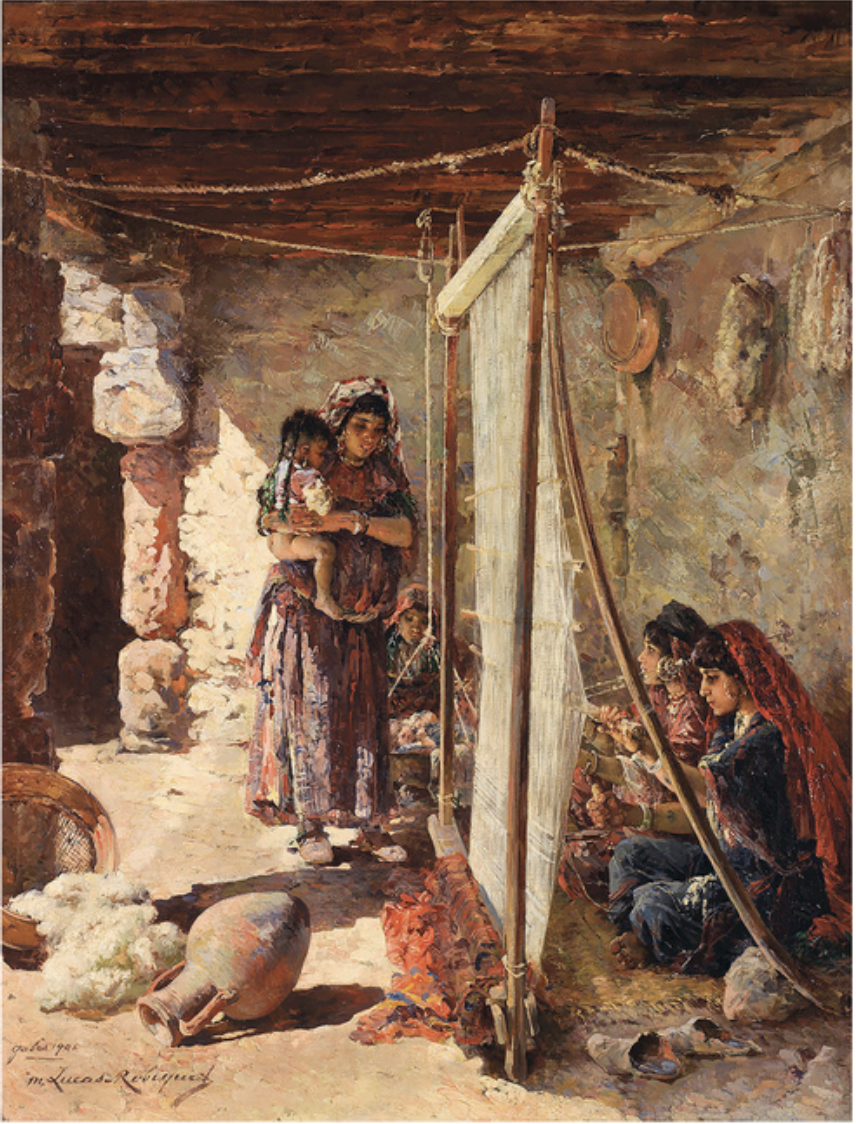
This art historical theory can be applied to a work of art by the artist Marie Lucas-Robiquet, Tisseuses à Gabès, Tunise (fig. 3). This painting depicts a domestic space with people working at a loom. In the center of the canvas a woman holds a child. To her right, two girls sit on the ground, working on the loom. In the background, you can distinctly see another small child sitting and leaning against the wall, probably spinning yarn or helping to prepare materials. In this instance, Lucas-Robquet’s painting acts as a lens into the domestic sphere seen in Tunisia, and textile production is being defined as ‘feminine.’ This is seen due to her inclusion of only women in this painting. As a French woman painting this, it is also interesting to see the ways in which Lucas-Robiquet is depicting an art form known by the European academy as feminine. At the same time, she creates a work of ‘fine art’ that would be considered masculine. Lucas-Robiquet adheres to notions of femininity associated with the creation of textiles while including visual components that help to define the individuals in the painting as women, but through an Orientalist perspective.
Not only does Tisseuses à Gabès, Tunise highlight textile production as a ‘feminine’ art form, but Lucas-Robiquet’s work also visually represents what defines being a woman in Tunisian culture. A large part of this was the involvement of the family in community labor and activities. This painting depicts this in a domestic setting with women and children, known to be a common practice in Tunisian culture, as mentioned before. Another notion is the brushwork that Lucas-Robiquet uses in this work. She uses a large brushstroke and thick paint, making it extremely difficult to identify the faces of the women in this painting. Instead of individuals, they are seen as symbols of women. In doing so, Marie Lucas-Robiquet defines and depicts these women as ‘other.’ In conversation with gender theory, Judith Butler says, “…feminist theorizing has come under criticism for its efforts to colonize and appropriate non-Western cultures to support highly Western notions of oppression, but because they tend to construct a “Third World” or even an “Orient” (Butler, 3). This construction of a ‘Third World’ most likely occurred at French salons, such as the 1906 Expositions Coloniales de Marseille where Tisseuses à Gabès, Tunise was exhibited. At this salon was a primarily male audience (Healy, 1182). With this being the case, women’s identities and cultural norms in Tunisia were transformed and perceived as ‘other.’
Women’s dress, as seen in the painting by Marie Lucas-Robiquet, is another way in which women are defined in Tunisian culture. A specific type of dress that is worn by Tunisian women is known as Raf Raf tunics (fig. 1 & 2). These are works that derive from the small town (of the same name—Raf Raf) on a headland southeast of Bizerte, Tunisia, which is famous for embroidery. These are traditional Tunisian textile works that women wear on their wedding day (Textile Research Center). The Raf-Raf embroidery is generally worked on a gourgaf or wooden frame with legs, using silk, wool, and gold threats on a cloth and/or tulle ground. The tunics are characterized by vivid colors, with a striped or checked cotton base, open front, and short sleeves (Textile Research Center). When women wear these tunics, it is a symbol of their femininity. They are symbols of femininity due to their association with women in a wedding ceremony in addition to their labor to produce the tunics. In addition, the future labor of a mother is depicted when wearing these tunics, foreshadowing the production of a family in a heteronormative familial structure.
The production of textiles in Tunisia is predominantly associated with women and is considered to be a feminine art form, according to European academic theory. With this being the case, it must be remembered that the cultural norms of Tunisian women are not a universal experience. Judith Butler says, “apart from the foundationalist functions that support the notion of the subject, however, there is the political problem that feminism encounters in the assumption that the term women denotes a common identity” (Butler, 3). There is not one universal experience of being a woman, and cultural differences impact assumptions made by observers. Yet, it is the works by Marie Lucas-Robiquet and her depictions of textile production that promote women’s roles as domestic and make them seem as ‘other’ by Western perspectives in France. She depicts these women from a French perspective, as another woman, but with a very different experience from the people she is painting. Through this exploration of Tunisian women depicted by a French artist in French-occupied North Africa, trans-Mediterranean differences are seen in the definition and associations that women and femininity have with particular art forms and their production.
Figures:

Figure 1: Embroidered marriage tunic, suriya mwashma (“tattooed tunic”), of cotton, wool, tulle, metal, and silk. Raf Raf village, Tunisia, 20th Century. W. 116cn (45 1/2 “), 1991, Af15.1.

Figure 2: Raf Raf wedding dress, made and worn in Tunisia.
Figure 3: Marie Lucas-Robiquet (1858-1959), Tisseuses à Gabès, Tunise, [Weavers in Gabes, Tunisia], 1906, oil on canvas, 122 x 94 cm, private collection.

Bibliography
Butler, Judith. “Subjects of Sex/Gender/Desire” in Gender Trouble: Judith Butler Feminism and the Subversion of Identity. Edited by Linda J. Nicholson. New York: Routledge, 1990. Pgs. 1-35.
“Chechia.” The Oxford Essential Dictionary of Foreign Terms in English. Oxford University Press. 1999.
Gerschultz, Jessica. “The Turn to Tapestry: Islamic Textiles and Women Artists in Tunis,” in Graves, Margaret S., and Alex Dika Seggerman, eds. Making Modernity in the Islamic Mediterranean. Bloomington, Indiana: Indiana University Press, 2022.
Healy, Mary. “Uncovering French Women Orientalist Artists: Marie Elisabeth Aimée Lucas-Robiquet (1858-1959).” Women’s Studies 44, no. 8 (2015): 1178–1199.
Holmes-Eber, Paula. Daughters of Tunis: Women, Family, and Networks in a Muslim City. New York, [New York]; Routledge. 2018.
Kelly, Mary. French Women Orientalist Artists, 1861-1956: Cross-Cultural Contacts and Depictions of Difference. Abingdon, Oxon ; Routledge, Taylor & Francis Group, 2021.
Perry, Gillian. “Introduction: gender and art history” in Gender and art. Yale University Press. 1999. Pgs. 8-31.
Textile Research Center, TRC Needles, TRC Leiden, Ra Raf Embroidery (Tunisia). Published in (Pre-) Modern Middle East and North Africa. Last modified on Saturday, 20 May 2017. https://trc-leiden.nl/trc-needles/regional-traditions/middle-east-and-north-africa/pre-modern-middle-east-and-north-africa/raf-raf-embroidery-tunisia.
Textile Research Center, TRC Needles, TRC Leiden, Raf Raf Bridal Outfits (Tunisia), Published in (Pre-) Modern Middle East and North Africa. Last modified on Saturday, 20 May 2017. https://trc-leiden.nl/trc-needles/regional-traditions/middle-east-and-north-africa/pre-modern-middle-east-and-north-africa/raf-raf-bridal-outfits-tunisia
