By: Lila Schaefer
The Venice Biennale is one of the most culturally significant art exhibitions in the world, and Venice’s status as a port city emphasizes the transnational Mediterranean relationships around it. The city’s position between Europe and Western Asia prompts notable artistic work relating to topics of migration and belonging. While Venice sits at a cultural crossroads, the Biennale has not consistently promoted a multicultural, decolonized perspective. This essay will discuss and respond to the Biennale’s colonial motives exposed by the inclusion of Swiss artist Christoph Büchel’s Barca Nostra in 2019, the subsequent response to Tsedaye Makonnen’s When Drowning Is The Best Option, and the exclusion of Palestinian artist Emily Jacir’s stazione from the exhibition in 2009.
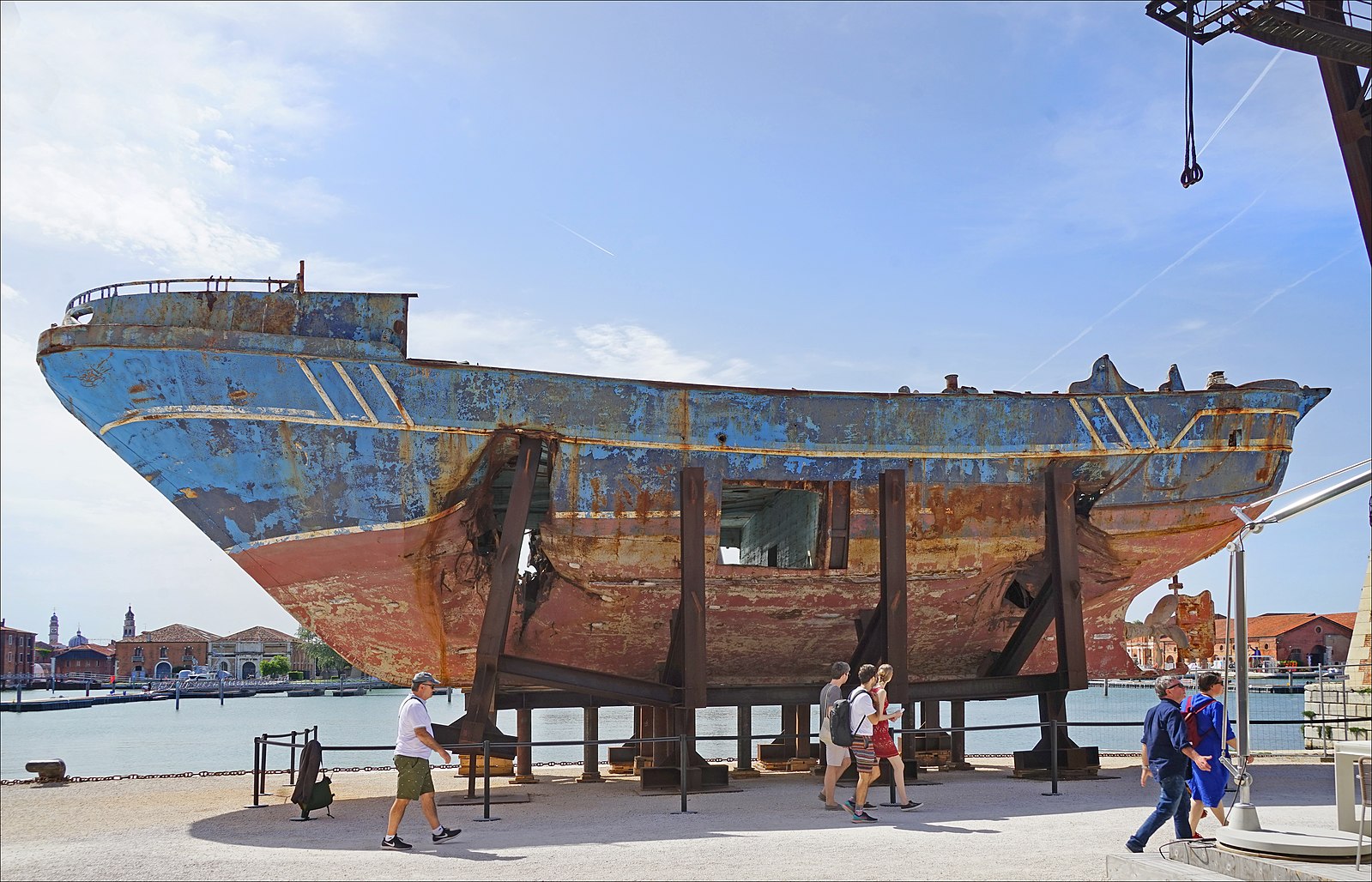
Büchel’s Barca Nostra (Figure 1) is a conceptual piece that caused controversy after being on display at the 2019 Venice Biennale. The recovered fishing boat that Büchel displayed as his “contribution” to the exhibition was in fact a gravesite for nearly 1000 migrants coming from Libya to seek refuge in Italy. While the boat’s capacity was 30 people, it is approximated that nearly 1000 were on board; there were only 25 survivors of the accident– a collision with a container ship on April 19, 2015 (Wilson, 69). This piece has received strong critique coming from all sides – some arguing that the piece is too political to be art, while others, like Josephine Wilson, argue that it is tone deaf and does not do enough to speak for the tragedy of the migration crisis (Wilson, 72). Placing the boat in the Arsenal, a military harbor within the lasoon, with no words or explanations, allows the viewer to marvel at the boat’s grandeur and decay while maintaining a degree of separation from the death and tragedy. This degree of separation is emphasized by the ship’s physical removal from the initial place where it was brought to land in Augusta, Sicily (Artforum, 2021). It is there that the damage was assessed, the victims identified, and a memorial garden was in place. Why did Büchel feel he was contributing to the piece by further removing it from this site? What does he add to the narrative? At the Biennale, the focus shifts to the image of the boat, rather than the tragedy or the colonial histories that led to the migration crisis. Italian occupation in Libya ended just 72 years prior to the sinking of the vessel, and the European country has acknowledged the negative impacts that the colonization had on Libya and offered some financial compensation (The New York Times, 2008).
The 2019 Venice Biennale was curated by Ralph Rugoff, who is an American but has been the director of the Hayward Gallery in London since 2006. He titled the 58th Biennale exhibition “May You Live in Interesting Times” inspired by an old Chinese curse that Rugoff felt was applicable to the world we live in today because of the increasingly tragic current events and political climate (La Biennale di Venezia). However, this title, particularly the choice of the word “interesting,” implies a sense of distance from these events. Despite including an exhibit as controversial as Barca Nostra in the exhibition, Rugoff explains, “let us acknowledge at the outset that art does not exercise its forces in the domain of politics” (La Biennale di Venezia). With a curatorial title that clearly references the tragic current events that are a reflection of the political climate, the hard line Rugoff appears to draw between art and politics neglects the role of art in societal change. To include art that sparks such conversation about current events, but to claim that it cannot be read alongside politics, parallels Büchel’s choice to not include any text or explanation alongside the display of Barca Nostra– to not explain the reason why he presents the ship art, rather than artifact.
Büchel’s exhibition caused such controversy that an Ethiopian-American artist, Tsedaye Makonnen, felt prompted to publicly respond to Barca Nostra at the Venice Biennale. A video of her performance, When Drowning is the Best Option, can be found on her website here. The textile she uses in this piece (Figure 2) gives name to her Astral Sea series, which is an extension of her work exploring Black migration. In the video, Makonnen wears the Astral Sea textile, a deep blue, long, rectangular fabric adorned with laser-cut mirror shapes. The blue cloth represents the water, and the mirrors represent the individual lives that were lost at sea, “symbolizing protection, healing, and memorialization” (Makonnen). We see Makonnen approach Barca Nostra and float the textile in the air before slapping it to the ground, where the contact between the mirrors and gravel makes a distinguishably loud noise. Initially, passersby do not pay much attention to her as she repeats this process, but when a Biennale representative approaches and tells her to stop, people start to film her with their cell phones. In their conversation, transcribed by Emily Hue in her article, “Tsedaye Makonnen’s Astral Sea: Critical Refugee Studies and the Black Mediterranean,” the representative demonstrates what type of value the Barca Nostra holds for the Biennale:
“Biennale Guard: ‘I’m sorry. Sorry.’
Makonnen: ‘Twelve hundred lives were lost on this boat.’
Biennale Guard: ‘Sorry, on the back the artist has directions . . .’
Makonnen: ‘Even if we’re commemorating the lives that died on this boat?’
Biennale Guard: ‘I know . . . but you can’t . . .’
Makonnen: ‘This is art? This is not a boat that people died in?’
Biennale Guard: ‘I know.’
Makonnen: ‘You’re protecting this as an object. Not as a boat that people drowned in?’ Biennale Guard: ‘I know.’
Makonnen: ‘You’re saying you know but you care about this as an art piece.’”
(Hue, 446)
In the video, we see the representative forbid Makonnen from fulfilling her goal of honoring the lives lost on the ship. Her statement claiming that the institution of the Venice Biennale cares about the Barca Nostra as an art piece, rather than as an artifact or piece of evidence–as an object that could be a dedication to the lives lost– illustrates the way that those who are privileged enough to be removed from this tragedy view these deaths as a spectacle, rather than as a consequence of the migration crisis. Not only do exhibitions like Büchel’s encourage a sense of removal from these events, but he also fails to acknowledge the histories of colonialism that tore colonized countries apart and led to the conditions that force migrants to cross the Mediterranean. In her discussion of Astral Sea, Hue similarly brings up the point of how “popular news media have consistently neglected how any ‘new’ refugee crises are built on vestiges of colonialism” (Hue, 443). In Visualizing Protest: African (Diasporic) Art and Contemporary Mediterranean Crossings authors Finley, Raiford, and Raphael-Hernandez explain:
“We want to highlight the ways the presentism of this debate about legal/illegal issues depends on a kind of racialized colonial amnesia that does not see these economic ‘migrants’ are the product of a long history of slavery and colonialism that has left many with few viable choices. As the colonial immigrant saying goes oft-repeated by pioneering British cultural studies scholar Stuart Hall about Caribbean and African migration to Britain: We are here because you were there.” (Finley, Raiford & Raphael-Hernandez, 258)
The dynamic explained in this quote often goes unacknowledged in art and media. The colonial perspective will always view the migrant as an other, not as a person who is a part of the history of the place they are seeking refuge in. It promotes an idea that colonized countries and the people in them, mostly in the global or relative South, are disposable. By consuming media that creates feelings of removal and separation from tragedies like the Mediterranean migration crisis, we fail to acknowledge the complex colonial histories between Mediterranean countries; we fail to see migrants as people. The boat displayed as Barca Nostra was traveling to Italy from Libya, which was under Italian occupation until 1951. In 2008, Italy agreed to pay Libya five billion dollars as a form of compensation for the damage done by the country’s period of colonization in the early 20th century (The New York Times, 2008). If Italy acknowledges this damage and understands the negative impact that its colonial rule still has on Libya today, then why must it be so difficult for Libyans to immigrate to Italy? Why are thousands of people each year forced to risk their lives on voyages like the Barca Nostra to leave the southern shores of the Mediterranean for European countries? The answer comes back to Büchel’s exhibition— the colonizer’s ability to distance themselves from the histories of the nations they occupied, from the tragedy of Black death, is prioritized. Hue states: “Barca Nostra does not only refuse to name deaths in the spirit of enigma, but also invites others to do the same” (Hue, 443).
This is not the first time that a colonial perspective has been prioritized at the Biennale. In 2009, ten years prior to the display of the Barca Nostra, Emily Jacir was set to represent Palestine at the Venice Biennale. Stazione, a project where she planned to translate the names of all 24 stops on Venice’s #1 water bus route, highlighted Arabic text alongside Italian and English translations already present on the station exteriors (Figures 3 & 4). Jacir planned to distribute a map of the water bus route written in English, Italian, and Arabic during the Biennale, yet her vision was never realized. Just before Jacir was set to install her exhibition, it was canceled by the Venetian authorities with no reason given. She was also not permitted to speculate on the cancellation of her exhibition in print, which begs the question of what the cancellation means (SAIC Digital Collections). Regardless of what went into the decision process of canceling stazione’s appearance at the Biennale, the lack of explanation given to Jacir displays lack of respect for Arab countries like Palestine and a desire to nix the multicultural perspective that comes through in Jacir’s work. In the eyes of the Venetian authorities and the Venice Biennale, what are the consequences of including the Arab language alongside Italian and English?
Despite never being implemented at the Venice Biennale, stazione was on display at the Simondi Gallery in Turin, Italy from March 17th to May 29th in 2010. Images from stazione’s proposal were displayed on the walls as prints, depicting what Jacir’s work would have looked like. The gallery’s website describes the significance of Jacir’s proposed project for the Biennale
“[the project] illustrates how such a simple and yet genial idea can reveal to us how boundaries separating two languages and cultures, which apparently make them incommunicable, can be broken down in translation; that translation can stand for trans-ducere (to lead across) from one bank of the Grand Canal to the other, or from one Mediterranean shore to another; and that the barrier between two spaces that are considered different, even counterpoised, can be crossed.” (Simondi Gallery)
The city of Venice’s decision to cancel Jacir’s showing sends a message that discourages togetherness and collaboration between the European and Arab worlds, which are so historically intertwined with one another. This is especially significant in a city like Venice, which sits at the crossroads between Europe and Asia, and has, historically, been significantly influenced by Arab culture.
Accompanying the images of stazione’s proposal in the gallery was embrace, a motorized sculpture, also by Jacir, that was meant to look like the conveyor belt at an airport luggage claim; its motion represents an eternal waiting time that for Jacir, speaks to the challenges faced by Palestinians, but can be applied to issues of displacement in any country (Figure 5). More imagery and information about the exhibit can be found on the Simondi Gallery website.
By including perspectives like Büchel’s and excluding artists like Makonnen and Jacir, the Venice Biennale sends a clear message: the colonial ideal should not be challenged. By allowing Büchel to exhibit a literal gravesite without an explanation, the institution displayed a failure to understand or acknowledge the trickle-down impact that choices like this have both artistically and politically. By shutting down projects that deliberately aim to provide a decolonized, multicultural perspective, the Biennale promotes separation. For people from marginalized communities, enforcement of colonial, patriarchal perspectives at the highest level of art creates a barrier to entry. Great art should make us think, not just look. The Venice Biennale has an opportunity–that they do not always take– to uplift artists who will promote inclusion, collaboration, and respect for all people regardless of where in the world they are from.


Bibliography
“VENICE BIENNALE IMPLORES CHRISTOPH BüCHEL TO RETURN MIGRANT SHIP TO SICILY.” ARTFORUM. December 22, 2020. https://www.artforum.com/news/venice-biennale-implores-christoph-buchel-to-return-migrant-ship-to-sicily-249010/.
“EMILY JACIR.” Simondi Gallery. https://simondi.gallery/en/exhibits/16-stazione.
Finley, Cheryl, Leigh Raiford, and Heike Raphael-Hernandez. “Visualizing Protest: African (Diasporic) Art and Contemporary Mediterranean Crossings.” Transition, no. 132 (2021): 254–69. https://www.jstor.org/stable/48680813.
Hue, Emily. “Tsedaye Makonnen’s Astral Sea: Critical Refugee Studies and the Black Mediterranean.” American Quarterly 74, no. 2 (2022): 441-452. https://doi.org/10.1353/aq.2022.0027.
“Italy to Pay Libya $5 Billion.” The New York Times, August 31, 2008. https://www.nytimes.com/2008/08/31/world/europe/31iht-italy.4.15774385.html.
Makonnen, Tsedaye. “About Astral Sea.” Tsedaye. https://www.tsedaye.com/about-astral-sea.
Rugoff, Ralph. “Introduction by RALPH RUGOFF Curator of the 58th International Art Exhibition.” La Biennale Di Venezia. https://www.labiennale.org/en/art/2019/introduction-ralph-rugoff.
“Stazione: A Project by Emily Jacir.” SAIC Digital Collections. (2019) School of the Art Institute of Chicago Library & Special Collections, https://digitalcollections.saic.edu/islandora/object/islandora%3A125214.
Wilson, Josephine. “Shipwreck, Without Label.” Performance Research 24, no. 8 (2019): 69-79. https://doi.org/10.1080/13528165.2019.1718433.
