An exploration of resilience against colonial forces in trans-Mediterranean collections
By: Sebastián León Fallas
The Mediterranean has become the most dangerous sea route utilized by migrants and refugees globally. In recent years, there have been numerous grave incidents involving boat capsizes and sinkings, resulting in the tragic loss of hundreds of lives (“The Mediterranean Migration Crisis: A Critical Challenge to Global Nation States”). In 2014, around 219,000 migrants and refugees endeavored to cross the Mediterranean, with over 3,500 lives tragically lost during the journey (“Latest Deaths in Mediterranean Highlight Urgent Need for Increased Rescue Capacity”). Due to the impact that events like this have had on different demographics inside and outside the Mediterranean geography, migration has become a central theme in trans-Mediterranean art and visual representations. As a place with a history of diverse cultural and sociological events from colonial influences, art practices across the Mediterranean offer a window to understanding past events marked by migratory movements as they continue shaping present realities.
Representations made by artists such as Kader Attia and Mona Hatoum, whose work centers on cultural identity, migration, and repair, ultimately speak on behalf of generational migratory experiences. Particularly, the detriment caused by the establishment of “borders” when becoming liminal spaces. Thus, the intersections between the experiences of the artists and the individuals they stand for at spaces like borders underscore broader issues at the structural level. This includes inconsistent migratory policies established by governments, unsafe conditions, economic disparities, and xenophobia caused by nationalist sentiments toward migrants. In turn, these representations speak up against these issues and propose the urgency of collective and coalitional work against colonial representations, particularly in contemporary art and visual culture. This proposes the use of borders, as liminal spaces, as a way of reclaiming identity, and as a form of resistance. In this essay, I explore the work of trans-Mediterranean artists Kader Attia and Mona Hatoum to understand how the concept and creation of liminal spaces are used as an oppositional tool against colonial forces historically embedded in the identity of thousands of migrant families over generations.
As a result of the increase in migratory processes and industrialized globalization worldwide, borders have become spaces for containment, arrest, and the active action of structural power by institutions. Likewise, states have established power dynamics and surveillance over the lives of migrants, and have based decisions on capitalist notions (Ianniciello 6). This is more evident as nation-states have compromised to an agenda that fosters cultural and identity homogenization giving rise to the reinforcement of borders. Correspondingly, this has resulted from the presumed risks that migrants represent for the safety and order of these nations. (Iannicello 7). This makes border spaces ripe for recurrent violence by impacting multiple migrant demographics in the process of seeking economic, social, and political stability no longer possible at their places of origin.
Borders, therefore, can be seen as liminal spaces; sites that represent movement, and transformation, and usually propose dualities such as present and future, becoming a rite of passage when moving from one side to the other (Fourney 2). Thus, the examination of borders as liminal spaces is central to migratory processes, particularly in understanding what occurs before, after, at one side or the other, and which agents play a role in shaping migrants’ experiences when crossing these human-made lines. As part of such interrogation, artists convey the burdens connected to barriers and borders through how they use creative practice to shape their artistic and personal experiences.
Collections on diasporas by Trans-Mediterranean artists Mona Hatoum and Kader Attia, employ objects that represent or interrogate liminal spaces, particularly borders, where suffering and pain are transmitted via the selection of harmful materials or objects associated with causing harm. Hence, they transform such harm, depicted via liminal spaces, into forms of healing and repair while reappropriating what was stolen from their identities through the meaning embedded in their artistic collections.
This is the case for North African and French artist Kader Attia. His work focuses on the idea of repair as both a physical and symbolic act, exploring simultaneously how repair relates to psychological and physical injury, and collective as well as individual trauma. This involves examining how the influence of colonialism and imperialism persists in shaping the interactions of Western societies with non-Western cultures, highlighting their ongoing impact on the representation of these cultures (“Kader Attia: The Museum of Repair”)
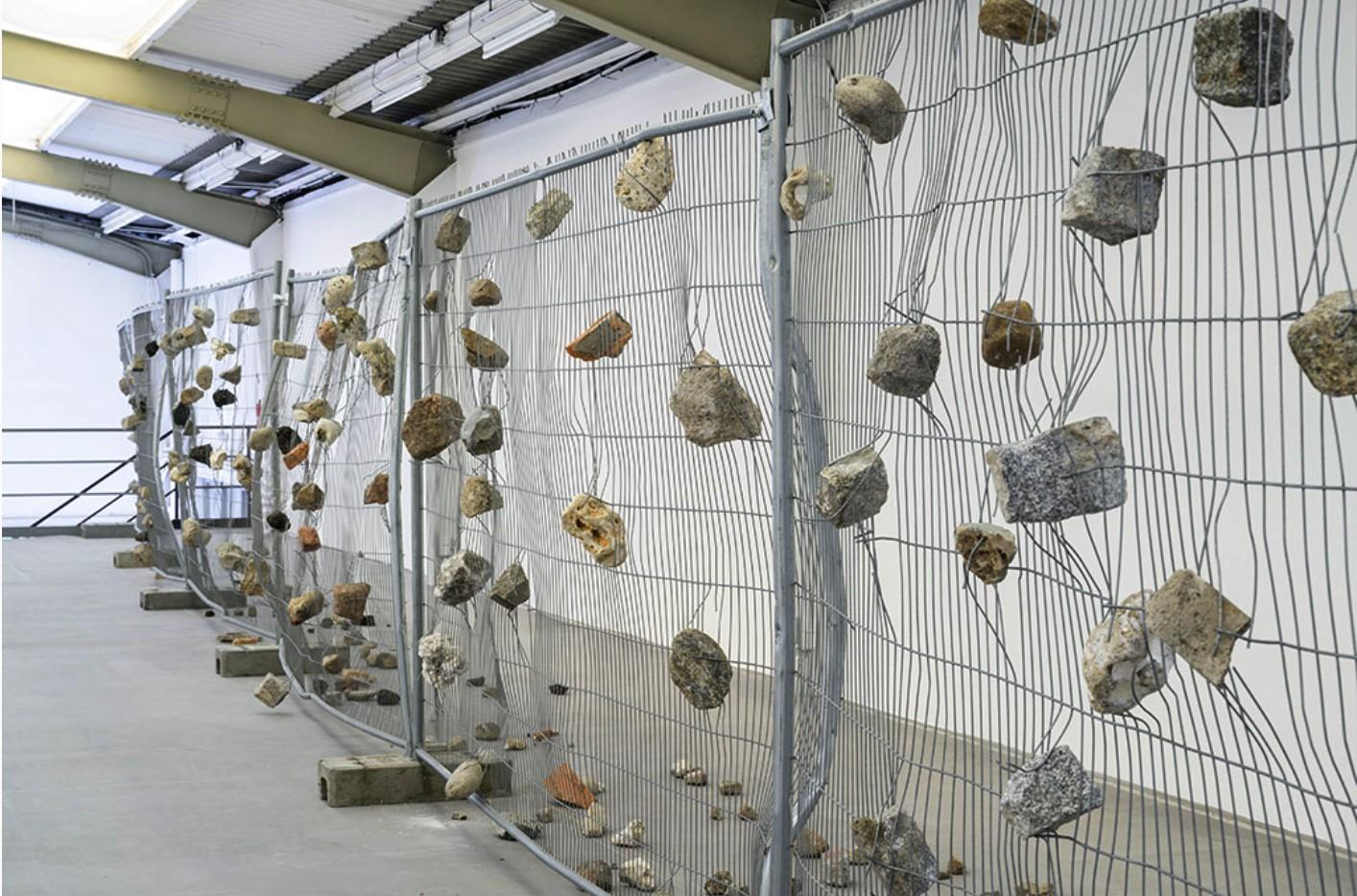
In his piece “On n’emprisonne pas les idées” (Meer) (Figure 1 Appendix), born out of the collective oppression experienced by the refugees residing around Stalingrad in Paris in 2018, Attia honors the tenacity of the fight and underscores the significance of actions that resist discrimination and constraints on freedom. As he believes, these ideas cannot be confined by any state or border, which is a strong feature employed by Attia in this piece as an example of social protest (“Silence Kills”). Kader Attia uses space and liminal zones to represent borders and the harm that comes with them, another common feature found in his collection. Here, Attia constructs the “physical barrier” with metal fencing wire that is punctured by large stones poking stones through it, suggesting a kind of destruction of the border/barrier. Looking closely, we notice that some sections of the fence are bent, giving a sense of pushing by migrants on these structures. Generally, when thinking about rocks, they are often associated with the potential to induce harm. In the context of the piece, this refers to the strength and opposition of migrants which is fundamented by the diversity of shapes and colors with the selected rocks; some are sharp, and round, depicting colors such as blue and brown. This selection of the artist might reference directly to the mobility or transition of refugees in the attempt to cross borders, coming from distinct backgrounds. It is important to notice the positioning of the rocks; while some are encrusted on the wall, others are scattered behind on the ground, which acknowledges those who did not make it through. These rocks are also sedentary and inanimate, referring to permanent damage and life-long memories attached to these borders. Ultimately, the creation of this liminal space by Attia as the title of the collection refers, opposes the control of ideas and experiences exploited and dominated by colonial forces in determining the agency and autonomy of the refugees’ lives, as a form of repair and healing. The creation of a liminal space is achieved by Attia via the purposeful placement of the fence in the middle of an empty room to denote a division from one side to the other. It then becomes a way to verbalize the realities behind migratory experiences through embedded metaphors of what borders represent. At the same time, it calls out the agents that play a role in inducing harm and pain through the implementation of borders.
Similarly, Lebanon-born artist Mona Hatoum, whose work is often characterized by the employment of Minimalism and Surrealism on gender and race, also explores the harm of liminal spaces in migratory processes. She achieves this by examining the intersection of politics and the individual through performance while also employing geometric forms that allude to systems of control (“Who is Mona Hatoum?”). She has created installations and sculptures made out of a wide range of materials, including elements found in households to create connections between common elements and broader issues. She also manipulates their size through magnification and alterations to criticize systems of control and power. The piece “Grater Divide” (“Grater Divide”), (Figure 2 Appendix) displays an unconventional room divider that is reminiscent of a cheese grater. It is made of metal with distinctive sections for different purposes. This alludes to the harm that exists in borders as both; imaginary and tangible spaces. The grater is transformed into a liminal space because it indicates passage, transition, and transformation. It denotes a limit or a border in the form of a room divider since the grater is placed in the middle of a spacious empty room, creating a duality from one side to another. As part of this transformation, the grater references migratory processes since once migrants cross a border, pieces of them are left behind or filtered (as a grater does with cheese) as well as referring to the painful and harmful process this entails.
The process rather becomes transformative, as the individual that crosses to the other side is no longer the same, a metaphor that is achieved through the employment of surrealism in using a grater as a barrier. The implementation of the grater as a border is reminiscent of how a common element found in households such as a grater, which is seemingly harmless, can become a potential threat once that is magnified. Similar to borders in the context of migration, the idea of magnifying a physical barrier to restrict passage also becomes detrimental. An idea resulting from the need to control and dominate people’s fate, employed at a large scale, ultimately produces detrimental and harmful effects for those who cross it. There is an exchange and transformation taking place between one side or the other, and it is exactly through the creation of this type of “liminal space” that such a process occurs.
The selection of a retractable wall to create the grater, makes the grater versatile and mobile, including the chance to close it completely, similar to a curtain. This evokes a powerful message concerning borders, migration, the collective imagination, and the experiences of the artist taken to a universal scale. Here, the volatility of the curtain in representing borders reflects the potential to modify and bend them as a form of protesting against their fixed and permanent creation to benefit nation-states.
Both artists Mona Hatoum and Kader Attia create distinct representations of liminal spaces to criticize the deleterious effects of geographical borders. In both cases, the construction of the grater and the wall are made of metal; a material conventionally understood to be harsh due to its occurrence in sharp items. This is employed to emphasize the feeling of damage produced by borders and their effects on those who transition through them.
Across these two pieces, details such as the rocks inserted on the metal wall and the distinct sharpened sections of the grater also represent harm and pain as common motifs. These constructions ultimately provide a barrier, or division between one side and the other, creating a duality between two spaces while also displaying a sense of uneasiness as you cross or move between these spaces. These representations of “borders” induce a permanent transformation in those who cross them, particularly via the motion through liminal spaces like borders.
These metaphors become an oppositional tool against colonial influences reflected in the creation of borders while representing the experiences and collective memories of those migrants who risked their lives or whose lives have been shaped as a result of these socio-political processes. Therefore, the employment of liminal spaces by both artists fosters discussions on repair and healing by decolonizing the canonical perspectives on migration. This is achieved when the points of view and personal experiences of the artists such as their cultural backgrounds are magnified to represent a higher collective issue. The creation of these installations challenges what borders stand for and what their outcomes are in real life. Finally, this style of work opens up a set of connections between colonialism and migration as critical frameworks in contemporary art and visual culture. This emphasizes the urgency for an interdisciplinary approach that accounts for different ways of knowledge production, work, and collaboration in protesting and opposing colonial narratives rooted in the field.
Appendix


Bibliography
“Art-Presentation: Kader Attia-Silence Kills.” Dreamideamachine ART VIEW. Accessed November 20, 2023. www.dreamideamachine.com/?p=60574.
Fourny, Marie-Christine. “The Border as Liminal Space.” Journal of Alpine Research | Revue de géographie alpine, November 1, 2013. https://journals.openedition.org/rga/2120.
Ianniciello, Celeste. 2018. Migrations, Arts and Postcoloniality in the Mediterranean. New York: Routledge.
“Kader Attia Biography.” Kader Attia Official Website. Accessed December 10, 2023. kaderattia.de/biography/.
“Kader Attia: The Museum of Repair.” Contemporary & (AND). Accessed December 10, 2023. https://contemporaryand.com/exhibition/kader-attia-the-museum-of-repair/
“Latest Deaths in Mediterranean Highlight Urgent Need for Increased Rescue Capacity.” UNHCR, n.d. www.unhcr.org/us/news/stories/latest-deaths-mediterranean-highlight-urgent-need-increased-rescue-capacity.
Mona Hatoum, “Grater Divide,” Artsy, accessed December 10, 2023. https://www.artsy.net/artwork/mona-hatoum-grater-divide.
“Silence Kills.” Meer. Accessed December 10, 2023. www.meer.com/en/60227-silence-kills.
“Translation as a Political Act in Times of Crisis.” Revue Germanique Internationale, 2013. https://journals.openedition.org/rga/2120.
“Who is Mona Hatoum?” Tate. Accessed December 10, 2023. www.tate.org.uk/art/artists/mona-hatoum-2365/who-is-mona-hatoum#None.
